Somehow I thought Karagwe was a 5 hour drive from Dar es Salaam, but as I’m flying to the northwest corner of Tanzania, to Mwanza, where I switch to a small propeller plane to go to the farther northwest corner town of Bukoba, on the western side of Lake Victoria, close to Rwanda, I’m realizing how important it is to check the spelling of a town name (Karagwe not Korogwe?) before committing to something.
I was introduced to Gary Zieff, who runs a firm called dissigno, that focuses on appropriate technology solutions in developing countries. Gary and team are launching an initiative in Karagwe to install a system using human powered generators - Pedal Power -- which will charge battery-powered lights that will replace kerosene lanterns and candles. Most of the region, like 95% of Tanzania, is off the grid and so households use kerosene lanterns (which are toxic and expensive). The Pedal Power initiative aims to set up a system so that people can rent these human power-recharged batteries and lights at a price below kerosene cost.
Dissigno was one of the sixteen winners of the World Bank Development Marketplace Lighting Africa competition. They competed against 500 participants, were selected and awarded $200,000 to test their pilot project in Tanzania.
Flying from Mwanza, on one side of lake Victoria, to Bukoba, on the other, took 40 minutes. The lake, the biggest in Africa, is truly vast, covering 26,000 square miles, making it the largest tropical lake in the world. It is bordered by Tanzania, Uganda, and Kenya, and is home to more than 3,000 islands. Rocky outcroppings dot a landscape of folded hills with occasional villages of scattered houses of cinderblock and tin or thatch. I learn that this land is well suited for the coffee and bananas that grow here.
Gary had asked if I could meet with their NGO partner, KADERES (Karagwe Development & Relief Services) to assess their level of enthusiasm and interest in the project. I spent my first afternoon with the Executive Director. This should have been familiar territory as I’ve done this due diligence questioning with a hundred nonprofits in the U.S. But this somehow was different.
Questions I asked, such as - how do people choose which Savings and Credit Organization (SACCO) to join, were met with answers beginning with, “we don’t do things here the way you do in America...” There is a decided tension to this development work (based on my, oh, one or two data points). On one hand, western development work is truly needed and welcomed. The government of Tanzania relies on western donors for 45% (!!!) for its annual operating budget. On the other hand, I get the feeling that there is a real desire to develop and implement home-grown solutions, and a touch of resentment of mzungu efforts.
The Pedal Power project is, like so much of the appropriate technology work being done here, designed to be an intermediate step. Using rechargeable batteries is not a hoped for permanent solution. But until billions of dollars are spent on infrastructure - to wire the country and get clean water - it will be many many years before most people have access to basic services.
I was put up in the $13 a night Hotel at Home. Water in the bathroom was in a large plastic tub for washing, and in the morning, they’d bring in another tub of hot water. This was as remote as I’d been. I was out of safe ex-pat comfortable Dar and in real Africa. It was exciting and surprisingly, didn’t make me as nervous as I thought I’d be. (Although if I start an NGO here, it will be called Hot Shower-Aid, because in my book, you gotta have a hot shower in the morning.
Hotel at Home did have a bar with plenty of cold beers, and I spent the evening talking to the local priest, who apparently was at the bar each evening. He asked me if I wanted to go to mass. When I told him I wasn’t Catholic, he started a guessing game, “Muslim? Anglican? Bahai?” When I said Jewish, he started laughing and said, “I know about that from studying at seminary.”
I travelled with Optatus, the accountant at KADERES, who provides technical assistance to the SACCO’s in the region. We drove out rutted dirt roads for many miles to visit three of them. When we went in, each a small office the size of two office cubicles, we were formally handed a guest book to sign. I signed, and scanned the names above. On each page, Optatus’s formal sign-in over the past few months was officially noted, and little else.
Each of these SACCO’s had about 2,000 members, and served as the regional savings bank and lender as farmers weather the cycles of crop harvests. I learned that virtually all of the members of the SACCO’s depended on kerosene for light in their house. I also asked for estimates of the amount spent per month, and all replied that approximately 5 liters were used per household per month, costing about $12. This is a huge burden for families getting by on under $400/year.
Before the visit, I thought the project was innovative but maybe cute. After the visit, I realize what a significant difference in so many lives, such a simple idea can have. The groups were excited. The biggest issue that they believe will need to be addressed is the initial plan to serve 3,000 families when so many more will be demanding the batteries.
Friday, August 29, 2008


Monday, August 25, 2008
Goat Races
 Yesterday found us crowding the outside of a track with 10 goats who, with no strong proclivity toward moving herd-like in any single direction, much less any interest in movement at all, were being shooed and pushed from behind around a race track. Over three thousand spectators cheered at the Dar es Salaam Charity Goat Races, but the goats didn’t seem to be relishing their moment in the limelight.
Launched in in 2001, the Goat Race was loosely modeled on Royal Ascot, but with noble racing steeds replaced by ornery goats. There is betting, of course, and tents serving champagne and drinks, and spectators in big floppy hats, loud music, and a kiddie area.
One of TechnoServe’s volunteer consultants (“volcon’s” is what they are called in Hillary's office) stayed with us for 6 weeks while she worked during the break in her MBA studies. Young and single, she quickly tapped into a nonstop nightlife culture -- late night restaurants, clubs, music and dancing -- that Hillary and I had no idea existed in Dar. There is a party society that parents of toddlers aren’t told about, much less invited to.
The goat races contained a melding of these different worlds. We saw some of Bodie’s young friends scrambling around with parents chasing after them. Hillary ran into colleagues from agencies with which she was working on projects. We also saw denizens of the night scene - women in strappy little dresses drinking champagne, and couples in dark shades (it was afternoon so unwelcome sunlight to the vampire crowd) crowding the bar tents.
Bodie jumped and cheered on the goats. As he did so, I thought that if his intellectual pursuits don’t work, he he may well have the perfect build to be a fine goat jockey.
The goats were “bought” or sponsored by locals and companies and we can only imagine that much of the intellectual firepower of Tanzania has been tied up for weeks in thinking of clever names (Fartaway Faraday, Kid Rock, Ethel the Aardvark Goes Quantity Surveying, Ghoti, Furcoatnoknickers, and Deep Goat, among them.)
The races raised $50,000 for a eight charities working to help those with disabilities in Tanzania. It was a great way for these charities, which work quietly in the shadows with a poor country’s most disadvantaged, to have some visibility and support.
Tuesday, August 12, 2008
Lewa Wildlife Conservancy Marathon
Hillary has been busy working. She has taken over an organization that was in decline and needed a turnaround. She is very competitive, and this helps drive her. It can also have her running off a cliff. Or at least through a game preserve. Our friend Laura tapped into this instinct of hers and challenged, although she’d say invited, Hillary to run a half-marathon at Lewa Wildlife Conservancy in Kenya. Hillary, who was – pre-Bodie, pre-Alfred – a runner of marathons, accepted.

Bodie, Hillary, Laura and I, along with Laura’s good friend Kalin, (aiming for the medal to be awarded to the first Bulgarian to cross the finish) left Nairobi early on Friday morning to make the four-hour drive north, past Mount Kenya to Lewa Conservancy. Lewa has 62,000 acres that include black rhinos, elephants, lions, warthogs, a rare, endangered type of zebra and pretty much any African animal you can think of. The area is savanna, vast grasslands with clusters of trees, and stretches as far as you can see. Driving through the park to the campsite, we saw grazing elephants, giraffes and zebras.
A sign welcoming everyone to the park read: "Warning. Endurance running in a a wildlife conservation area is an inherently risky activity. You participate entirely at your own risk."
The campsite teemed with hundreds of tents. Sponsored by Safari.com, the largest cell phone company in Kenya, there was a bar tent, music, and Masai dancing. About 600 people (fact checker - please verify) were running, of which 150 were running a full marathon.
We camped around a campfire with others from Laura’s company, Pesa Point, who were part of the team. Here is where some of our planning fell short. When camping with a two-year old, it is important to think through a few basic questions in advance. Like, for instance, where is he going to sleep? We had a tent, two pads and two sleeping bags. In camping, it is protocol to bring your own stuff. “Bodie, where’s your stuff?” we asked. Nothing.
So we zipped two mummy-style sleeping bags together and tried to settle Bodie down to sleep. Sleep? Why? There is a tent to bounce in, and soft sleeping bags to bounce on, and animal noises and people talking around a campfire outside, and, did I mention that there is a tent?
Strike 1: Hillary had been busy at work and had amassed total training mileage the month before of, oh, zero.
Strike 2: According to experts, sleep may be a factor in how one feels and performs the next day. This thing that we call “sleep” was not so evident the night before the marathon.
But offsetting the strikes – we camped in a stunning game preserve. We heard animals through the night – elephants, a cheetah (Hillary swears) although I’m guessing it was a warthog, maybe hyenas in the distance, and saw more stars glittering in the night sky then we’ve ever seen before. We stood at our tent and watched the sun setting with an elephant no more than a hundred yards away. A family of baboons sat on fallen trees, staring at the campers waking from tents when we woke up.
During the marathon, Bodie and I raced around in a pickup truck to catch up with Hillary, Laura and Kalin and cheer them on. I scanned the savannah, trying to eye different game. Bodie was more preoccupied with the two helicopters that were hovering in the near distance, scaring off the animals so they wouldn’t munch laggardly runners.
At the mid-point, Bodie handed bottles of water to passing runners. Well, he stood for a good four minutes, arm outstretched, but everyone seemed to choose water at waist height. When Hillary showed up, Bodie yelled, as we’d practiced, “go mama go!”. She stopped, hugged him, and started to go. He burst into tears, to which Hillary replied: “I feel your pain.”
The folks running the full marathon were mostly Kenyans, with many world-class runners taking part. This is a different type of runner than we normally see jogging around the park. They are thin, all muscle and sinew, with legs that run from the ground directly to their shoulders. At the finish, they were ahead of most of the runners completing the half-marathon, and strode in, after 26 miles in the hot sun, at full bore. It was stunning to see these human gazelles effortlessly loping across through the savannah.

Bodie, Hillary, Laura and I, along with Laura’s good friend Kalin, (aiming for the medal to be awarded to the first Bulgarian to cross the finish) left Nairobi early on Friday morning to make the four-hour drive north, past Mount Kenya to Lewa Conservancy. Lewa has 62,000 acres that include black rhinos, elephants, lions, warthogs, a rare, endangered type of zebra and pretty much any African animal you can think of. The area is savanna, vast grasslands with clusters of trees, and stretches as far as you can see. Driving through the park to the campsite, we saw grazing elephants, giraffes and zebras.
A sign welcoming everyone to the park read: "Warning. Endurance running in a a wildlife conservation area is an inherently risky activity. You participate entirely at your own risk."
The campsite teemed with hundreds of tents. Sponsored by Safari.com, the largest cell phone company in Kenya, there was a bar tent, music, and Masai dancing. About 600 people (fact checker - please verify) were running, of which 150 were running a full marathon.
We camped around a campfire with others from Laura’s company, Pesa Point, who were part of the team. Here is where some of our planning fell short. When camping with a two-year old, it is important to think through a few basic questions in advance. Like, for instance, where is he going to sleep? We had a tent, two pads and two sleeping bags. In camping, it is protocol to bring your own stuff. “Bodie, where’s your stuff?” we asked. Nothing.
So we zipped two mummy-style sleeping bags together and tried to settle Bodie down to sleep. Sleep? Why? There is a tent to bounce in, and soft sleeping bags to bounce on, and animal noises and people talking around a campfire outside, and, did I mention that there is a tent?
Strike 1: Hillary had been busy at work and had amassed total training mileage the month before of, oh, zero.
Strike 2: According to experts, sleep may be a factor in how one feels and performs the next day. This thing that we call “sleep” was not so evident the night before the marathon.
But offsetting
 the strikes – we camped in a stunning game preserve. We heard animals through the night – elephants, a cheetah (Hillary swears) although I’m guessing it was a warthog, maybe hyenas in the distance, and saw more stars glittering in the night sky then we’ve ever seen before. We stood at our tent and watched the sun setting with an elephant no more than a hundred yards away. A family of baboons sat on fallen trees, staring at the campers waking from tents when we woke up.
During the marathon, Bodie and I raced around in a pickup truck to catch up with Hillary, Laura and Kalin and cheer them on. I scanned the savannah, trying to eye different game. Bodie was more preoccupied with the two helicopters that were hovering in the near distance, scaring off the animals so they wouldn’t munch laggardly runners.
At the mid-point, Bodie handed bottles of water to passing runners. Well, he stood for a good four minutes, arm outstretched, but everyone seemed to choose water at waist height. When Hillary showed up, Bodie yelled, as we’d practiced, “go mama go!”. She stopped, hugged him, and started to go. He burst into tears, to which Hillary replied: “I feel your pain.”
The folks running the full marathon were mostly Kenyans, with many world-class runners taking part. This is a different type of runner than we normally see jogging around the park. They are thin, all muscle and sinew, with legs that run from the ground directly to their shoulders. At the finish, they were ahead of most of the runners completing the half-marathon, and strode in, after 26 miles in the hot sun, at full bore. It was stunning to see these human gazelles effortlessly loping across through the savannah.
Friday, August 8, 2008
Camp Graduation
Camp Msasani ended for the summer. It was wonderful to spend time with Bodie and 14 toddlers beach combing, making art, singing and dancing. What was amazing, and un foreseen, was how the nannies (each kid was accompanied by one) gelled so that they’d start singing at a moments notice. The songs, all from their youth and in Swahili, have certain movements, and these two year old kids learned to put their hands on their hips and shake, or raise their hands to their heads, singing, “ay ay ay kipepeo, kipepe”.
One of my initial goals in coming to Dar was to get to know Tanzanians, and I’ve felt thwarted in that. But over the summer, I’ve been able to spend a good part of each day with 14 Swahili-singing, dancing and drumming women.
Last Thursday, after a mind-challenging exercise of finding and counting 10 things on the beach, the kids came up to the house for a brief graduation ceremony. Each received a certificate of achievement and a Camp Msasani t-shirt with primary colored handprints stamped by each camper. Each nanny received a camp t-shirt with “staff” emblazoned on the sleeve.
 foreseen, was how the nannies (each kid was accompanied by one) gelled so that they’d start singing at a moments notice. The songs, all from their youth and in Swahili, have certain movements, and these two year old kids learned to put their hands on their hips and shake, or raise their hands to their heads, singing, “ay ay ay kipepeo, kipepe”.
One of my initial goals in coming to Dar was to get to know Tanzanians, and I’ve felt thwarted in that. But over the summer, I’ve been able to spend a good part of each day with 14 Swahili-singing, dancing and drumming women.
Last Thursday, after a mind-challenging exercise of finding and counting 10 things on the beach, the kids came up to the house for a brief graduation ceremony. Each received a certificate of achievement and a Camp Msasani t-shirt with primary colored handprints stamped by each camper. Each nanny received a camp t-shirt with “staff” emblazoned on the sleeve.
Parents came for this first graduation and the nanny’s started dancing and singing the 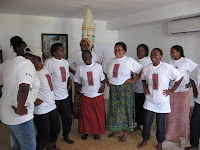 songs they’d been singing to the kids all summer. All the parents stood and cheered the show, and I thought smugly to myself that I’ve had the luxury of being a part of this for six weeks. If anyone is considering starting a Tanzanian summer camp, a good selection of songs include: Jambo, jambo bwana, Mauwa Mazuri, Ukuti Ukuti, Watoto Wadogo, Kofia Yababu, Lingu Lingu, Tulingeba yuyo, Saa yakwenda kwetu, and the classic Simama kaa.
 songs they’d been singing to the kids all summer. All the parents stood and cheered the show, and I thought smugly to myself that I’ve had the luxury of being a part of this for six weeks. If anyone is considering starting a Tanzanian summer camp, a good selection of songs include: Jambo, jambo bwana, Mauwa Mazuri, Ukuti Ukuti, Watoto Wadogo, Kofia Yababu, Lingu Lingu, Tulingeba yuyo, Saa yakwenda kwetu, and the classic Simama kaa.
Friday, July 11, 2008
Green Acres
We planted/had our gardener plant a small vegetable garden with tomatoes, peppers, and cabbage. Since we are living in our own-created small community of Tom and his wife, Judith the housekeeper, and Grace the nanny, our thinking was we’ve always loved the idea of growing our own vegetables, and everyone else would as well.
So I bought seeds for some vegetables I knew and recognized. Tom also planted something called mchicha, which is a locally eaten spinach-type green, tembeye, a sort of sweet potato, and corn.
The irony is, the 85% of the country’s GDP is agriculture-based, and the same proportion of the populace are small farmers, with most being subsistence farmers. They grow what they need to live. People behind walls with staff in the house don’t grow vegetables, they buy them. But I’ve always had the organic farmer fantasy without the energy or enthusiasm to actually weed and care take a garden. This garden-delegation project seemed like a dream realized.
We planted in April and it’s now been a few months. The tomato plants are diseased, with a white powdery looking fungus on the leaves, and a fair number of small green tomatoes that have been small and green for some time, and don’t seem inclined to ever get big or red. The pepper plants produced a few gumball-sized green peppers, suitable for stuffing with a single small mushroom, or a half-teaspoon of breadcrumbs. The cabbage refused the invitation to even venture out of the soil.
It is funny that in the midst of my thinking through various work and occupation options here, it is easy to strike the entire gardening/organic-farming category right off the list.
So I bought seeds for some vegetables I knew and recognized. Tom also planted something called mchicha, which is a locally eaten spinach-type green, tembeye, a sort of sweet potato, and corn.
The irony is, the 85% of the country’s GDP is agriculture-based, and the same proportion of the populace are small farmers, with most being subsistence farmers. They grow what they need to live. People behind walls with staff in the house don’t grow vegetables, they buy them. But I’ve always had the organic farmer fantasy without the energy or enthusiasm to actually weed and care take a garden. This garden-delegation project seemed like a dream realized.
We planted in April and it’s now been a few months. The tomato plants are diseased, with a white powdery looking fungus on the leaves, and a fair number of small green tomatoes that have been small and green for some time, and don’t seem inclined to ever get big or red. The pepper plants produced a few gumball-sized green peppers, suitable for stuffing with a single small mushroom, or a half-teaspoon of breadcrumbs. The cabbage refused the invitation to even venture out of the soil.
It is funny that in the midst of my thinking through various work and occupation options here, it is easy to strike the entire gardening/organic-farming category right off the list.
Thursday, July 10, 2008
Complexities
A few things have gone missing around the house – Hillary’s Walkman that she uses for running can’t be found. She has somehow managed to lose two new blackberry phones in the past few months. More disturbing, her wallet seems to have been riffled. Hillary asked if I had taken money as the bills were turned in a different way than she puts them in (this is the wallet that has been with her since college, so she has deeply formed habits about its usage.) Two weeks ago, Hillary had an advance of three hundred dollars for a trip she was about to take. The day after getting the advance, she went for lunch and there were only two one hundred dollar bills in her wallet. Last week, she received her monthly local draw, the portion of her salary that is supposed to see us through the month. That envelope, containing $1,000, was gone the next morning.
We had started wondering who might be pilfering and ran through the list of every potential suspect. Was it someone from Hillary’s office? Was it Judith, our lovely housekeeper? Under that warm, caring façade, could she be nabbing our cash? Or Grace, who we entrusted with Bodie? And on and on.
It was a rough period of a few weeks, feeling betrayed, not knowing by whom, and feeling uncomfortable around the house. We assumed it was someone at Hillary’s work place, so Hillary held a meeting of her key team at the office to figure out who could be stealing. But when the thousand-dollar envelope went missing, we sat and, like good CSI-devotees, figured out a minute-by-minute scenario of who could have had access and opportunity.
Hillary received and signed for the envelope at 5:30 pm. She discovered it missing at 11 am the next morning. So we traced her steps: upon receiving it, she put it in her bag, which was by her feet, and worked until 6:45 pm, whereupon she left for home. By the time she got home, Judith and Grace were well gone for the day. The bag went on the kitchen counter by the door, where it goes every night. She left for work the next morning at 7:45 and had her bag with her until she looked for the money at 11 am.
There didn’t seem to be any opportunity for anyone, even a knowing and stealthy financial person, to grab the envelope at the office. But how could it have happened at home? Judith and Grace were gone, and no one else came in the house.
Hillary called me at home that morning and asked me to check if it were possible to reach in through the kitchen window to the bags on the counter. I tested the theory, and it was not only possible, it was easy.
Ok, the money was taken between 7 pm and 7 am, and the window in the kitchen seemed to be the point of access. That narrowed the list down to three, Sebastian, the night guard, who I’ve referred to as the happiest man on the planet, Tom, the devout seventh day Adventist gardener or his wife, Martha. If it were Tom or Martha, Sebastian would have to have watched them pad over to the kitchen window and either just let it happen, or collaborate. If it were Sebastian, he knew when everyone was asleep, had the role of walking around the house to check things out, so needed to be by the kitchen in the middle of the night, and knew everyone’s habits. It seemed to be coming clear.
My plan was to wait a week, put another envelope in the bag, and I’d sneak into the kitchen in the dark and wait, stealthily (and hopefully awake) through the night to capture the culprit in the act.
We called Knight Support, the agency that provides security and for whom Sebastian works, and told them of our suspicions. The operations head asked us if anyone else lived on the property. We told him Tom and Martha did, but that it would be both very difficult for them, and we had huge trust in them. He asked where they were from. When we said Malawi, he responded, “That’s all I need to know.” And launched into a diatribe against Malawians, the vehemence and nature of which I’d only seen in movies and footage depicting prejudice a century ago. We told him that it was possible, but highly unlikely given his devout church-going nature and lack of opportunity. “Those Malawians are like that, acting one way and stealing from right under your noses,” he said.
That night, Knight Security had a new super-askari, James, at the door, and sent a local supervisor to bring Sebastian back to the main office. I never got to enact my catch-‘em in-the-act plan.
We’ve thought about this a lot. The initial anger at being betrayed was quickly tempered by putting ourselves in his shoes. If I earned 80,000 shillings a month, or about $850 per year, had a wife and 4-year-old son, and access to $1,700 (the total amount we think was taken, not including the stuff), would I reach through a window in the middle of a long, dark and lonely night? The temptation of two years salary coupled with the need to provide for a family on $75 per month makes it hard to be outraged.
It is the mix of relationship and need that makes easily reconciling this difficult – Sebastian brought his son over one Sunday; he made little bicycle-men for Bodie; and repeatedly listened patiently as I struggled to form sentences in Swahili. He also apparently quietly pocketed money and things that he assessed, probably rightly, that he needed far more than we did.
We had started wondering who might be pilfering and ran through the list of every potential suspect. Was it someone from Hillary’s office? Was it Judith, our lovely housekeeper? Under that warm, caring façade, could she be nabbing our cash? Or Grace, who we entrusted with Bodie? And on and on.
It was a rough period of a few weeks, feeling betrayed, not knowing by whom, and feeling uncomfortable around the house. We assumed it was someone at Hillary’s work place, so Hillary held a meeting of her key team at the office to figure out who could be stealing. But when the thousand-dollar envelope went missing, we sat and, like good CSI-devotees, figured out a minute-by-minute scenario of who could have had access and opportunity.
Hillary received and signed for the envelope at 5:30 pm. She discovered it missing at 11 am the next morning. So we traced her steps: upon receiving it, she put it in her bag, which was by her feet, and worked until 6:45 pm, whereupon she left for home. By the time she got home, Judith and Grace were well gone for the day. The bag went on the kitchen counter by the door, where it goes every night. She left for work the next morning at 7:45 and had her bag with her until she looked for the money at 11 am.
There didn’t seem to be any opportunity for anyone, even a knowing and stealthy financial person, to grab the envelope at the office. But how could it have happened at home? Judith and Grace were gone, and no one else came in the house.
Hillary called me at home that morning and asked me to check if it were possible to reach in through the kitchen window to the bags on the counter. I tested the theory, and it was not only possible, it was easy.
Ok, the money was taken between 7 pm and 7 am, and the window in the kitchen seemed to be the point of access. That narrowed the list down to three, Sebastian, the night guard, who I’ve referred to as the happiest man on the planet, Tom, the devout seventh day Adventist gardener or his wife, Martha. If it were Tom or Martha, Sebastian would have to have watched them pad over to the kitchen window and either just let it happen, or collaborate. If it were Sebastian, he knew when everyone was asleep, had the role of walking around the house to check things out, so needed to be by the kitchen in the middle of the night, and knew everyone’s habits. It seemed to be coming clear.
My plan was to wait a week, put another envelope in the bag, and I’d sneak into the kitchen in the dark and wait, stealthily (and hopefully awake) through the night to capture the culprit in the act.
We called Knight Support, the agency that provides security and for whom Sebastian works, and told them of our suspicions. The operations head asked us if anyone else lived on the property. We told him Tom and Martha did, but that it would be both very difficult for them, and we had huge trust in them. He asked where they were from. When we said Malawi, he responded, “That’s all I need to know.” And launched into a diatribe against Malawians, the vehemence and nature of which I’d only seen in movies and footage depicting prejudice a century ago. We told him that it was possible, but highly unlikely given his devout church-going nature and lack of opportunity. “Those Malawians are like that, acting one way and stealing from right under your noses,” he said.
That night, Knight Security had a new super-askari, James, at the door, and sent a local supervisor to bring Sebastian back to the main office. I never got to enact my catch-‘em in-the-act plan.
We’ve thought about this a lot. The initial anger at being betrayed was quickly tempered by putting ourselves in his shoes. If I earned 80,000 shillings a month, or about $850 per year, had a wife and 4-year-old son, and access to $1,700 (the total amount we think was taken, not including the stuff), would I reach through a window in the middle of a long, dark and lonely night? The temptation of two years salary coupled with the need to provide for a family on $75 per month makes it hard to be outraged.
It is the mix of relationship and need that makes easily reconciling this difficult – Sebastian brought his son over one Sunday; he made little bicycle-men for Bodie; and repeatedly listened patiently as I struggled to form sentences in Swahili. He also apparently quietly pocketed money and things that he assessed, probably rightly, that he needed far more than we did.
Thursday, July 3, 2008
Camp Redemption
Bloodied but unbowed, I refuse to let those toddlers get me down. Today found some redemption. With Thursday camp being at George and Mie’s house on the beach, I wanted to take advantage of what the kids wanted to do anyway. After the morning singing circle, I passed out an empty jelly jar to each.
The tide was low, leaving countless shallow tidal pools. The kids waded into the tidal pools (each with a nanny) and looked at small darting fish, scurrying hermit crabs, shells, and floating forests of seaweed. Nannies and children chased small fish, wading from rock pool to pool. The exercise, planned for 30 minutes, went for over an hour as kids ran and splashed and filled their jars.
They came up from the beach for snack time, wet, diapers full of seawater, giddy with playing in the ocean, carrying jars with small fish. The arts and crafts activity was construction paper with crayons and stickers in the shape of, yes, a fish! The day was thematically coherent (always essential to a two-year-old), and seemed, for the first time, to fly by.
The tide was low, leaving countless shallow tidal pools. The kids waded into the tidal pools (each with a nanny) and looked at small darting fish, scurrying hermit crabs, shells, and floating forests of seaweed. Nannies and children chased small fish, wading from rock pool to pool. The exercise, planned for 30 minutes, went for over an hour as kids ran and splashed and filled their jars.
They came up from the beach for snack time, wet, diapers full of seawater, giddy with playing in the ocean, carrying jars with small fish. The arts and crafts activity was construction paper with crayons and stickers in the shape of, yes, a fish! The day was thematically coherent (always essential to a two-year-old), and seemed, for the first time, to fly by.
Monday, June 30, 2008
A Three Hour Cruise...
 Nothing to make one yearn for a desk job like hard, grueling labor. Take, say, cattle roping, working an offshore oilrig, or heavy construction. All look pretty cush after three days of three hours straight with 15 toddlers.
Yes it’s joyful to spend time and share in the innocence and play of children blah blah blah. But I am wearing out the little belt holster on my cell phone from checking the time so often. It is astounding the pure elasticity of time from, say, 10:42 to 10:44. Can that really only have been two minutes? We just sang, crawled like crabs and did an art project? In
 contrast to the Buddhist idea of relaxing into the impermanence of everything, that time is passing and so shall all things, I may well have discovered the one thing that brings time to a clawing, numbing, screeching halt.
So 15 kids – Adler, August, Bodie, Bennett, Clara, Ethan, Hannah, Jessie, Joshua, Juri, Kanto, Marisa, Matthias, Rohan and Sadie. All cute and charming individually. Put them together and I feel like the targeted Piggy in Lord of the Flies.
This week we tried a range of activities: collecting and painting rocks like lady bugs, singing everything fro
 m Rolly Polly to I’m a Little Tea Pot, dancing to Aloyce the drummer, and crown-making This is the stuff of college application essays.
Lessons learned from week one at Camp Msasani:
- Many short activities are needed. The morning is now broken into 8 different segments ranging from circle time/singing to art activities to movement activities, with plenty of free time.
- Hydrate hydrate hydrate – dealing with toddlers for three hours is, according to experts, comparable to running a marathon. So lots of liquids, carbo-loading, and glucose gel.
- Have bloody mary’s ready at 11:30 pick-up. It gets parents there on time and is a nice carrot to make it through the morning.
- Change Ivy League curricula to somewhere address toddler’s mercurial needs. Maybe cut a little Milton or Shakespeare and substitute with something more real world, like how to deal with a screaming two year old in the midst of a temper tantrum because the dog won’t let her grab its tail.
- Finally, don’t worry if you screw up. Stay just shy of permanent traumatization and you’ll be fine. They won’t remember any of this, because, hey, they’re only two years old!
Subscribe to:
Posts (Atom)
